Beginner plan, skewed to counter sitting and adjusted to be spine-safe after your CT scan: posture pulling, glutes, posterior chain, deep core and hip/hamstring mobility lead the way; chest, quads and arms are optional extras (soccer covers your legs). One identical session, three times a week. Tap any thumbnail for a short muted form demo.
The same session every time — Monday, Wednesday, Friday. Repeating it is deliberate: you get three practice sessions a week at each lift, technique improves fast, and progress is easy to track because you're always comparing like with like. Work top to bottom — posture pulling first while fresh, then hips and legs, then core last. Ramp-up = easy prep sets (reps@% of working weight); they don't count toward the working sets shown.
Back rules from your CT scan
Never round your lower back under load, and don't arch past neutral either. No loaded spinal twisting. Stop and see your doctor if you get new leg weakness, spreading numbness, or bladder/bowel changes.
Warm-up · Easy cardio
Stationary bike at an easy pace until lightly sweating.
Warm-up · Dynamic mobility
Cat–Cow ×8, leg swings ×10/leg, glute bridges ×10, bodyweight squats ×10, hip-flexor stretch ×20s/side.
 ▶muted
Chest-Supported DB Row (incline bench)
Bench ~30–45°, chest on the pad so you can't swing — the easiest way to feel your upper back. Drive the elbows back, squeeze, pause 1s.
 ▶muted
Rear-Delt Machine (reverse fly)
Your most important anti-desk-posture move. Chest on the pad, pull the arms back, squeeze the rear delts. Light, controlled, no shrugging.
 ▶muted
Back Extension (STRICT neutral spine)
SPINE-SAFE: never round your back on the way down, and STOP AT NEUTRAL at the top — don't arch past straight. Bodyweight until easy, then hug a light plate.
 ▶muted
Hip Thrust Machine
Re-activates glutes that switch off from sitting. Pad low on the hips, chin tucked, ribs down, pause at the top — don't hyperextend your lower back.
 ▶muted
Seated Leg Curl
Direct hamstring work. Slow on the way down. Keep your back flat against the pad.
 ▶muted
Leg Extension
Quads (kept light — soccer already trains them). Squeeze at the top, no swinging.
 ▶muted
Pallof Press (cable)
Anti-rotation core at the cable stack; resist the twist. Don't use the rotary-torso machine — loaded spinal twisting is wrong for your disc.
 ▶muted
Side Plank
Builds the weak lower side (obliques/QL). A standard back-rehab exercise — no spinal bending involved.
 ▶muted
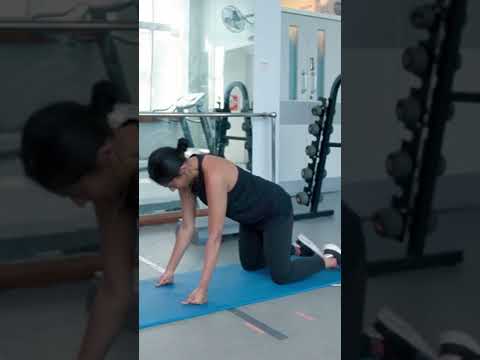
Bird-Dog
Trains the lower back to stay stable without bending it. Move slow, hips level, don't arch.
 ▶muted
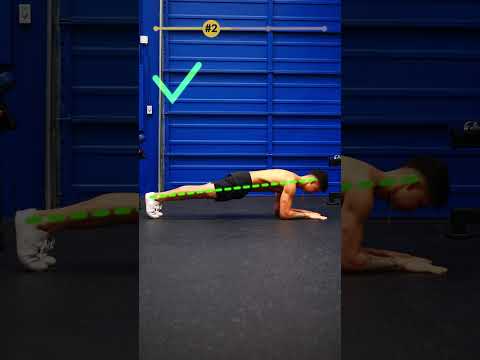
Plank
Brace hard, glutes tight, flat back — never let the hips sag.
 ▶muted
Optional extras — only if you have time left over. The chest press keeps your shoulders balanced against all the pulling.
Lat Pulldown
Optional vertical pull. Lighter than feels natural, lead with the elbows, pause at the bottom.
 ▶muted
Machine Chest Press
Optional — keeps your shoulders balanced against all the pulling. Steady tempo, don't lock the elbows.
 ▶muted
Dumbbell Lateral Raise
Optional shoulder width. Light, lead with the elbows.
 ▶muted
Everything you've logged, newest first. Saved in this browser on this device — copy or export a backup now and then so you don't lose it if you clear browsing data or switch phones. Your old records are safe: exercises that were renamed have been carried across automatically, and anything no longer in the plan still appears below.
Copy as table pastes straight into Notes, Excel or Google Sheets. Copy backup / Export file give you JSON you can bring back with Import.
Your cardio comes from sport & a class — no extra treadmill needed.
Tuesday · Indoor Soccer
Interval cardio — sprints + recovery jogging. Warm up with light jogging and leg swings first to protect knees/hamstrings.
Thursday · BodyAttack
High-energy Les Mills class mixing running/jumping/lunging with push-ups & squats. Scale the impact moves while you build up.
Sunday · Outdoor Soccer
More ground covered than indoor. Warm up before kickoff, especially the day after leg work.
Do this ~10 min, 5–7 days a week — the fastest fix for tight hips and hamstrings from sitting. Never force or bounce.
Standing Hamstring Stretch
Soft knee, hinge from hips, don't bounce.
 ▶muted
Lying Hamstring Stretch (strap)
REPLACES the seated forward fold. On your back, towel or strap around one foot, raise the straight leg. Stretches the hamstring with zero bending of your lower back — the spine-safe version.
 ▶muted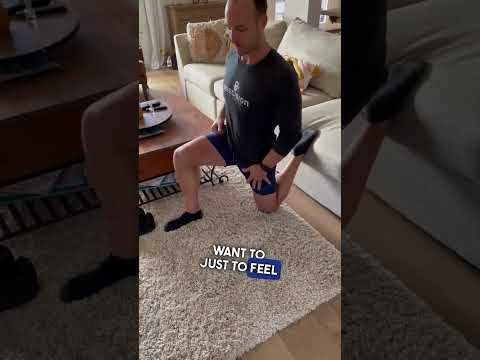
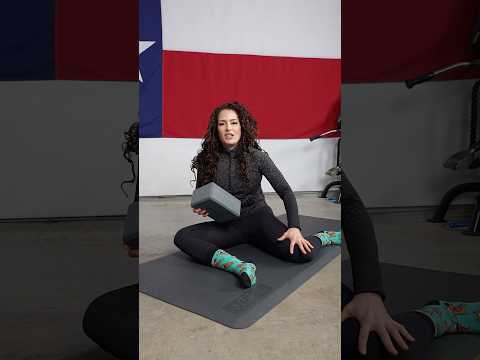


Stomach Vacuum
Tightens the deep transverse abdominis (the corset muscle) to flatten the belly. Exhale fully, pull navel to spine, breathe shallow while holding. Daily, even at your desk.
 ▶muted
Back rules from your CT scan
Your August 2026 CT showed disc bulges at L4-5 and L5-S1 touching but not compressing the nerve roots, mild facet joint wear, and a flattened lumbar curve from muscle spasm. Nothing is broken and no nerve is meaningfully pinched, but three rules now shape the plan:
1. Never round your lower back under load — that pushes disc material toward the nerve. Hence strict neutral-spine back extensions, and the lying hamstring stretch instead of the seated forward fold.
2. Don't arch past neutral either — hyperextending compresses the facet joints. Stop back extensions when straight; keep ribs down on hip thrusts.
3. No loaded spinal twisting — skip the rotary-torso machine; the Pallof press trains anti-rotation instead.
This is general guidance, not medical advice — have your doctor and a physio review the scan and clear you. Seek medical attention for new leg/foot weakness, spreading numbness, or bladder/bowel changes.
Why the same session every time?
As a beginner you get three practice sessions a week at each movement, so technique improves quickly. Progression is also far easier to judge — you're always comparing like with like, which is exactly what the log is for. Just don't max out every session; leave 1–2 reps in reserve most days.
Flattening the belly (loose abs)
A belly that sticks out despite low body fat is mostly a slack deep core — the transverse abdominis, your waist corset. (An earlier version of this plan blamed anterior pelvic tilt; your CT shows the opposite, a flattened curve, so that doesn't apply to you.) The fix: bracing core work (Pallof, side plank, bird-dog, plank) plus the Stomach Vacuum in the Mobility tab — daily, even at your desk. Give it 4–8 weeks. Fat around the middle comes off via walking and calorie balance, not ab exercises. If you see a vertical ridge down your abs when sitting up or feel a lump, get a doctor/physio to rule out diastasis recti or a hernia.
Why this plan leans posterior
Sitting all day shortens your hip flexors and hamstrings, switches off your glutes, weakens your lower back, and rounds your upper back. So the plan loads back extensions, hip thrusts, leg curls, rows and rear-delt work, trains core every day, and keeps hip/hamstring mobility daily. Chest, quads and arms are trained lighter on purpose — they get plenty from pressing, soccer, and the pulls.
Warm-up, every lifting day
1) 5 min easy bike. 2) Dynamic mobility (cat–cow, leg swings, glute bridges, bodyweight squats, hip-flexor stretch). 3) Ramp-up sets per the cards — 2 easy sets before the first big lift, 1 before other compound lifts, none for isolation/core.
Why 8–12 reps
~1–5 reps = max strength, 6–12 = best for size, 15+ = endurance. Muscle grows across the range if you push close to failure — so 8–12 hard reps builds as much as heavy 3–5s with far less stress on your back. Keep the last 1–2 reps genuinely hard.
Progression
Beat last session by a rep or a small weight bump. Double progression: hit the top of the rep range on all sets, then add the smallest weight and drop to the bottom of the range. Log every set. Leave 1–2 reps in reserve.
Recovery
Protein ~1.6–2.2 g/kg/day. Sleep 7–9 h. Slight calorie surplus to gain muscle. Stand and stretch every 45–60 min of sitting. Sharp pain (not normal fatigue) = stop and swap; if back pain persists, see a physio.